
by Chris Hunter
Share
TL;DR
- Friday (my chief of staff) can now approve blog posts for one of my businesses. Publishing stays a separate step it doesn’t have.
- First live run: 20 pieces of content, 72 checks passed, 6 warnings, 0 failures.
- My first unattended Monday brief missed half my meetings because of Labor Day. Its search window rolls now.
Two things this week. I handed my AI a little more authority, and my Monday brief tripped over a holiday.
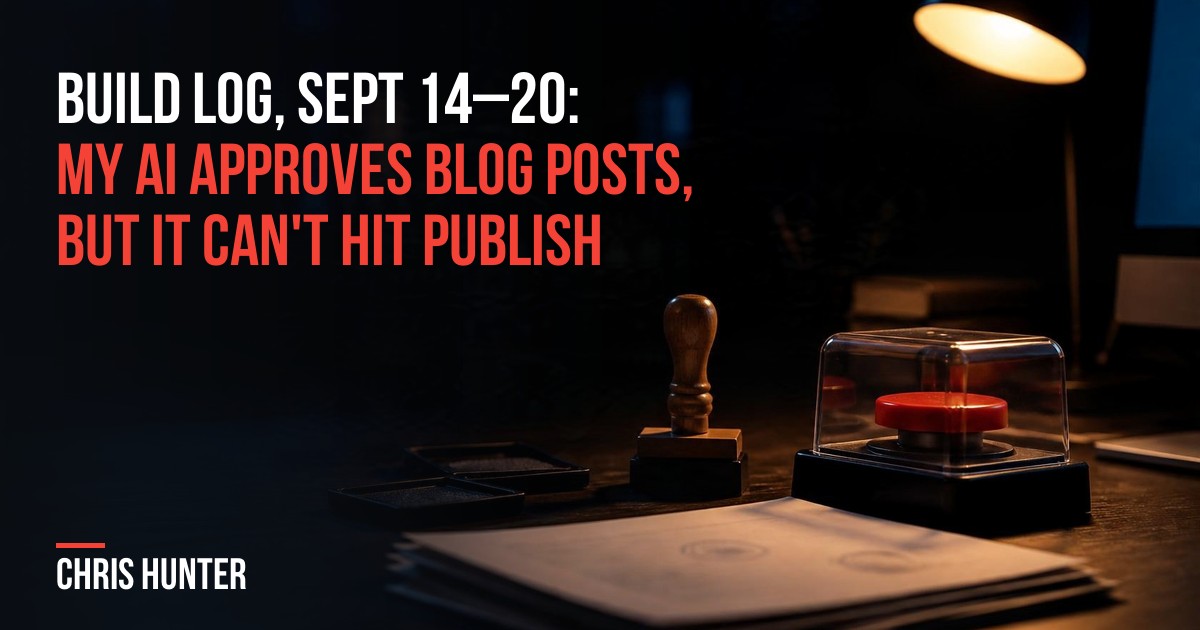
My AI approves blog posts now. It still can’t publish them.
Friday is my chief-of-staff agent. Until this week, every piece of content my marketing engine wrote for one of my businesses waited on one person to say yes. Me.
I built that bottleneck on purpose. It’s also why content stalls the second I get busy.
If you own a business, you know exactly how that goes. The posts are written and sitting in a queue, and they’re fine. They sit there for a week because you’re the only one who can say “go,” and you spent that week putting out fires. Nobody reads a post that never went up.
So I gave Friday one narrow new permission. For a cleaning business I own, it builds the week’s content, runs every piece through a pass/fail gate, and approves the blog posts on my behalf.
That’s where its authority stops. Approving a post and publishing a post are two separate steps, and Friday only got the first one. It never hits publish.
I kept it small on purpose. One business. One kind of content. One decision.
The first live run was the real test. I didn’t care whether it could approve a good post. Any rubber stamp can do that. I wanted to know if it would approve a post I’d have rejected, because that’s the failure that would actually cost me. A bad post with my approval on it goes out looking like I meant it.
It didn’t.
That cycle produced 20 pieces of content. The gate ran its checks: 72 passed, 6 came back as warnings, and nothing failed.
Then I widened it a notch. Friday ran the same approval pass across the rest of October’s blog posts and approved 5 more, every one of them clean.
Blogs only, though. The social posts and graphics from that same cycle still came to me. Friday showed them to me for review. It didn’t sign off on them.
If you’re weighing whether to let an AI make calls inside your business, this is the size of handoff I’m comfortable with today: a decision I can see, with a line it can’t cross.
Handing over that first yes felt like handing a new hire the keys to the truck. You don’t give them the whole fleet on day one. Friday earns the next permission the same way a person would: by running clean on this one long enough that I stop checking behind it.
My first unattended Monday brief missed half my meetings
Smaller one.
Every Monday morning, Friday writes me a brief built from the week’s meeting transcripts: who said they’d do what, and what I need to chase before the week gets away from me. This was the first Monday it ran on its own, with nobody kicking it off.
It missed half the meetings.
Nothing crashed. The brief searched a fixed window for last week’s meetings, and Labor Day had pushed half of them out of it. So it reported them as missing and kept going.
An error message gets my attention. A brief that looks finished and is quietly missing half its inputs doesn’t.
The fix was simple. The window is now a rolling seven days, counted back from whenever the brief runs. A holiday can shove a meeting a day or two and it still lands inside.
I re-ran it, and it pulled in 2 meeting transcripts it had marked missing the first time.
Every automation I build quietly assumes a normal week. Labor Day wasn’t one.
Need help building something like this?
Everything I write about here runs in my own business first. If the AI job landed on your plate, start with an assessment: where AI will make or save you the most money, and what it'd take to run it right.
About the Author: Chris Hunter

Share

Oct 1–8 build log: a local AI video editor that finished three podcast episodes, overnight builds from my AI agent, and two quiet sites.
A hard stop that keeps my AI agents from messaging people, moving money or deleting anything without me, plus a site move finished in one evening.

Build log, Sept 21–27: an AI that checked which leads were real (495 of 495 tag changes, 0 errors) and an early-warning brief that went dark for a week.

Claude Code now reads AGENTS.md, the cross-tool standard behind Codex and Cursor. Why one portable instruction file matters, and what I'm doing about it.